

Headaches
I think we can all agree that headaches are terrible. Almost everyone has experienced one. Unfortunately, some people experience them frequently – and they can be super disruptive to your concentration, sleep, work, and general ability to function.
There are also many different types of headaches – and you can experience more than one at a time! Some of the most common are due to stress, lack of sleep, dehydration, and poor posture. On the bright side, conservative treatment and prevention can often significantly reduce their frequency and severity, and in some cases help them resolve entirely.
What Are Headaches?
Headaches are when you have pain somewhere in or on your head. Sometimes they can feel deep inside or behind your eyes, while others are more surface like your temples or the back of your head. If you experience visual disturbances (aka aura) or nausea of vomiting along with a headache, you may be suffering from a migraine.
There are many different headaches, which is why there is no one-size-fits all solution to addressing them.
Common Types of Headaches
There are so many different kinds of headaches that they are sometimes named after their location, but sometimes named after their causes.
Frontal headaches, where you experience pain in your forehead, the bridge of your nose, or behind your eyes, tend to be due to allergies, sinus infections, or whiplash accidents. Temporal headaches are when you feel pain at the sides of your head, especially at your temples. Temporal headaches are often due to stress or poor posture. Suboccipital headaches are located at the base of your skull (named after the suboccipital muscles there), and those are often due to staring at a computer screen for hours, driving, or poor posture.
Tension headaches are ones brought on by stress. These are typically at the sides of the head like temporal headaches, but they can also present as a tight “band” around your head, along with tension in your neck and shoulders.
Sinus headaches are caused by inflamed or infected sinuses, so you typically feel dull, achy pain and/or pressure in your sinuses, forehead, bridge of your nose, and cheekbones.
Hormonal headaches affect women as they are related to fluctuations in estrogen levels during the menstrual cycle. Many women notice hormonal headaches improve during pregnancy or after menopause, although this isn't true for everyone.
Exertion headaches can be triggered by intense physical activity, such as heavy exercise, but also after prolonged bouts of coughing and sneezing.
Less commonly, you can experience Cluster headaches. These are rare but severe. You can experience burning, piercing pain around or behind one eye. They occur in cyclical “clusters.”
Common Symptoms of Headaches
Pain in the head – forehead, sides of the head, back of the head
Sinus pain
Eye pain
Trouble concentrating
Irritability
Poor reaction times
Common Causes of Headaches
Stress
Sinus infections
Eye strain from staring at screens or not wearing sunglasses outside
Seasonal or environmental allergies
Dehydration
Poor posture
“Sleeping funny” or waking with a headache
Food allergies or sensitivities
Hangover from alcohol or other drugs
Hormones
Referred pain from your neck
Where you feel the pain isn’t always where the problem begins – which is why we always need to do an evaluation!
Tips to Prevent Headaches
Manage stress
Drink water
Ensure proper sleeping positions
Make sure you have the right pillow for you
Avoid sleeping on couches and air mattress
Take regular breaks from sitting and staring at screens
Keep screens at eye level
Stretch throughout the day
Make sure your car is set up properly for your body and take breaks when driving long distances
When Should You See a Doctor Immediately?
Most headaches are manageable, but there are certain “red flags” that you should not ignore:
Stiff neck
Confusion
Fever
Vision loss
Paralysis
If the headache you have currently is different from your “usual” kind, I recommend getting into urgent care or the emergency room ASAP.
If it’s the “worst headache you’ve ever had,” that can be a sign of a stroke, so call 911 and get to the hospital.
The B.E. F.A.S.T. method can help you more easily identify a stroke:
B - Balance: Sudden loss of balance, coordination, or difficulty walking.
E - Eyes: Sudden changes in vision, such as double vision or loss of vision in one or both eyes
F - Face Drooping: Sudden facial numbness or drooping. Ask the person to smile to check if one side sags or is uneven.
A - Arm Weakness: Sudden arm (or leg) numbness or weakness. Ask the person to raise both arms to see if one drifts downward.
S - Speech Difficulty: Sudden slurred speech, trouble speaking, or confusion. Ask them to repeat a simple phrase to check for clarity.
T - Time to Call 911: Time is critical. Even if symptoms disappear, call emergency services immediately and note the exact time the symptoms started
How Chiropractic May Help Headaches
Chiropractic is often helpful for posture-related headaches, which are probably the most common kind.
Most people are constantly looking down – at their phones, tablets, keyboards, books, etc. Looking downward for prolonged periods of time causes the muscles in front of your neck (such as the SCMs) and your chest (pecs) to tighten up and shorten, which in turn can further pull you forward. And once the joints of the neck lose their normal alignment, they may gradually lose their normal movement, which puts you at higher risk of developing degenerative conditions like arthritis.
Now you’ll notice that when you look down, you’ll have pulling from the muscles at the back of your neck. And if you look upward, you will have reduced range of motion and likely also some pinching or pain.
Your neck can also be misaligned from accidents or injuries, such as whiplash from a car accident or falling off a bicycle. Your neck can also be pulled forward, like when you go to lift your child and they tug your head forward or if you let a child ride on your shoulders.
From my martial arts background, I can also tell you that you can be pulled forward if you engage in the arts of Brazilian Jiu Jitsu, Judo, or Aikido – or any art where you practice throws or other techniques involving the neck.
Once your neck is misaligned, now all of the muscles of your neck and mid-back have to work harder to keep your head up. That’s why you can feel so tired physically at the end of the day, even if you “just sat in your chair doing nothing.” And when muscles work harder, they get tight; and when they get tight, they develop trigger points or knots. These trigger points can refer pain to other locations – such as your head.
In the image below, the black X’s are the trigger points in the muscle, and the red pattern is where the pain is referred to. So like I said earlier – your headache may not actually be coming from your head at all!
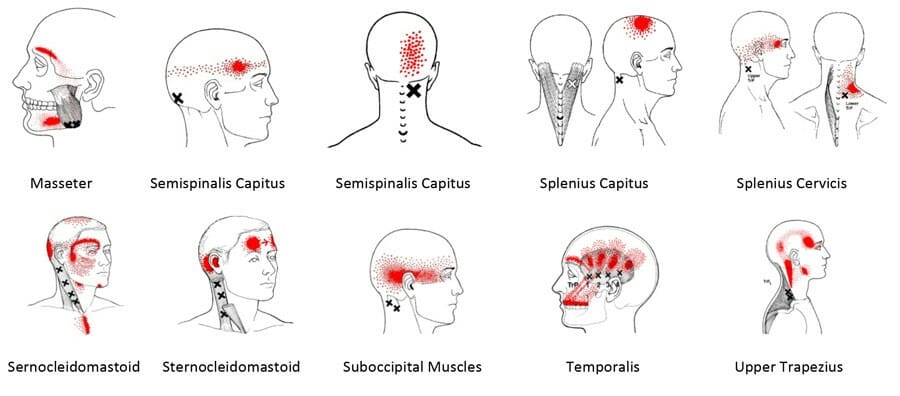
The goal of chiropractic, specifically my Pulley Method, is to help realign your spine to take the abnormal pressure off your joints and allow your muscles to stop working so hard all of the time. When your muscles can go back to just moving your neck, not fully supporting it, you’ll stop developing trigger points and your headaches should reduce and, for many people, may resolve altogether.
We will also talk about how to set up your desk and other ergonomic concerns so that you do not re-injure yourself while healing and in the future.
How Acupuncture May Help Headaches
I find that acupuncture is fantastic for people suffering from stress-related headaches (or migraines). But it can also be great as an add-on treatment with the chiropractic because we can work on releasing those tight muscles sooner with needles, cupping, or gua sha (scraping).
From an acupuncture point of view, headaches are from your qi (aka chi or body’s energy) getting stuck up in your head. Most frequently this stagnation in your head is because your neck is tight, which prevents the qi from flowing back downward. Many of the best acupuncture points for headaches and migraines are actually located on the feet because they help to “ground” your qi.
Here is a great resource that talks about common acupuncture points for headaches and migraines and how to stimulate them with acupressure at home.
I can also put intradermal needles (little baby needles that stick on the points that you can basically wear until they fall off) on the acupuncture points on your feet to try to keep pulling your qi down in between visits.
What To Expect During Your Visit
During your visit, we will go over your headaches and health history to find out the root cause of your headaches. I look at you from both a chiropractic and acupuncture point of view. Then I will do an examination, and if necessary, we will order imaging. Hopefully we can get you treated the first day with whichever treatment makes the most sense for you and get you feeling better!
Dr. Janine’s Clinical Perspective
Have you ever done massage, acupuncture, Graston, PT, myofascial release, or any other treatment where they work out trigger points? Do you feel better for a few days, but then the pain comes back?
One common reason is that the underlying cause hasn't been fully addressed. In many of the patients I see, abnormal spinal alignment and posture continue placing stress on the muscles, so the trigger points eventually return. (If it was a simple muscle issue, working on the muscle alone should resolve it.
On the bright side, you’ve definitely found the right chiropractor to help! 😊
Mini FAQ
Q: Can neck problems really cause headaches?
A: Absolutely! The muscles and joints of your neck share nerve pathways with your head. That's why tension, poor posture, or restricted movement in the neck can sometimes lead to headaches — a type commonly called a cervicogenic headache. Part of my evaluation is determining whether your headache may be coming from your neck or from another source.
Q: Will you adjust my neck?
A: No, I do not believe it is necessary to adjust the neck above C7 (C7/T1 is the base of your neck). I have helped hundreds of people suffering from headaches without using the dreaded “neck crack” technique!
Q: Will my headache go away immediately?
A: Hopefully! 🤞 I always hope for a one and done, but most people have been suffering from headaches for years, so it can take some time to get to the root and heal. In my experience though, most people do get moderate to significant relief in the first 1-3 visits.
Q: Do you adjust my head?
A: Yes! I have a technique where I use a small balloon to go up your nose to adjust the cranial bones. It is similar to EndoNasal, Neurocranial Restructuring (NCR), Cranial Facial Release (CFR), or Functional Cranial Release (FCR). When done correctly, it doesn’t hurt at all and most patients report immediate and significant relief!
Q: Can acupuncture help headaches?
A: Yes, acupuncture can be a fantastic, minimally invasive, drug-free way to address your headaches. And it can be used safely in addition to other treatments, such as chiropractic, PT, massage, OT, etc. My only recommendation is to not do acupuncture and massage on the same day as they work similarly and you deserve 2 mini-vacations. 😉
Related Conditions & Resources
For headaches:
Sinus issues
Mid-back pain
Food sensitivities
What I Want My Patients to Know About Headaches
I want you to know that you are not alone. Headaches can be debilitating – mentally and emotionally, not just physically – and modern medicine really does not have many solutions other than drugs. (If you need medication, that is one thing; but if you’re just throwing prescription after prescription at the problem with no progress, that’s another thing.)
I used to suffer from daily headaches for as along as I could remember. Mine were primarily suboccipital, but they would radiate into my eyebrows and forehead as well. I woke up with them daily, and they would get worse after studying or drawing (my goodness, you should have seen the angle of my neck when I sat and worked!) I took at least 2 Advil every day to manage them. I thought this was “normal.”
It wasn’t until my mom brought me to the chiropractor for terrible low back pain that I even realized that headaches could be addressed. I was shocked how much more alert and alive I felt not having the fog of a constant headache. This experience is what led me to become a chiropractor.
I realized in chiropractic school everything I wrote above, and I went out of my way to fix my environment to support my body. I make sure I sit up straight rather than slouched on a couch. I adjusted my computer screen to be the right height for me. I moved my car seat so I sit up straight instead of leaning back and to the side. I got an adjustable pillow and a firm mattress to support my posture while sleeping.
And most importantly – I stopped reading in bed. I used to lay on my back with a pillow under my neck with a book on my chest, and I read for hours. I had significant insomnia (which you will inevitably experience if you are as misaligned as I was), so I had to read into the wee hours of my night until I literally passed out in order to sleep. But that pillow under my neck posture is what pushed my neck forward until I developed neck pain and headaches. And then I’d sleep funny all night and wake up with a terrible headache every day.
Now, I really only get headaches when I knock myself out of alignment, use a computer for too long, or am very tired. (I would argue these are “normal” headaches.)
Not sure whether chiropractic or acupuncture is the right fit for your headaches? That's okay. One of the goals of your first visit is to determine what's causing your symptoms and whether chiropractic care or acupuncture is likely to help. If it isn't, I'll tell you - and if needed, I'll help point you toward the next appropriate step.