

Sciatica
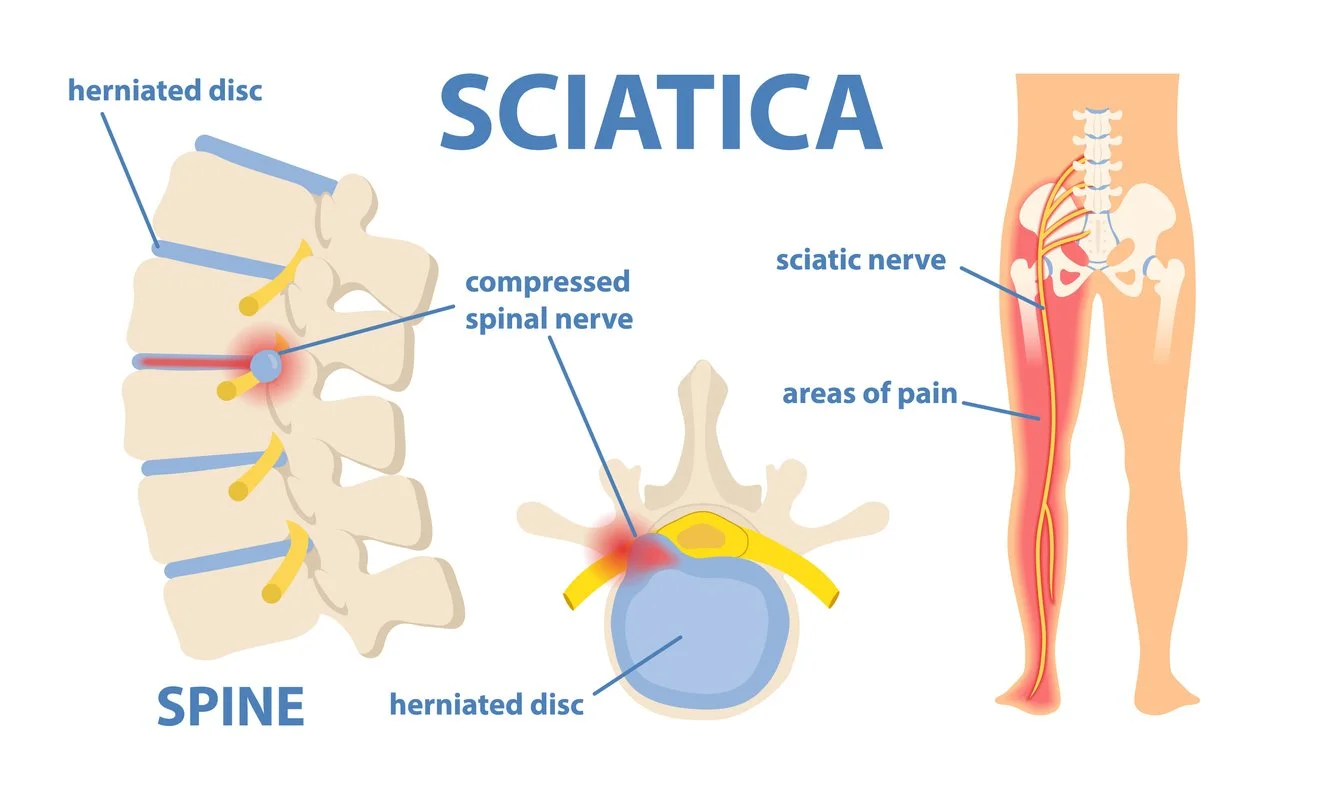
Sciatica is pain that travels from your lower back down your sciatic nerve, which runs through your buttock and down the back of your leg. Some people experience pain that radiates all the way down to their foot.
The most common cause of sciatica is a lumbar disc herniation. A disc is a flexible cushion between the vertebrae. If part of the disc bulges or herniates, it can irritate or place pressure on one of the nerve roots that eventually forms the sciatic nerve. Inflammation around the irritated nerve may add to the pain, numbness, or tingling. Pain that worsens with coughing, sneezing, laughing, or bearing down may suggest irritation of a spinal nerve root, which can occur with a disc herniation.
Other common causes of sciatica are spinal stenosis or bone spurs. Spinal stenosis refers to the narrowing of the canal around the spinal cord, which is the result of long-term degeneration aka arthritis. Bone spurs are a type of arthritis that occur around the foraminal openings where the spinal nerves exit; they are also the result of long-term degeneration.
Common Symptoms of Sciatica
Low back pain that radiates into your buttock
Low back pain that radiates down the back of your leg
Pain in just your buttock
Pain just down the back of your leg
Sharp, burning, or electric shock pain shooting down your leg
Numbness or pins and needles in the leg or foot
Common Causes of Sciatica
Disc herniation
Spinal stenosis
Bone spurs, which are one sign of arthritis
Poor posture
Tight muscles
Accidents and injuries
Tips to Prevent Sciatica
Engage in proper posture when sitting, especially for long periods of time
Regularly get up and move during long periods of sitting
Use proper form when lifting objects, even if they are “not that heavy” or you’ve “lifted it before”
Exercise regularly
Get adjusted as a preventative
When Should You See a Doctor Immediately?
When Should You Schedule an Evaluation?
Symptoms lasting longer than one week
Pain that is worsening or limiting normal activities
Persistent numbness or tingling
Symptoms that repeatedly return
When Should You Seek Urgent or Emergency Care?
New or rapidly worsening leg weakness
Foot drop
Numbness in the groin or saddle area
New loss of bladder or bowel control
Difficulty starting urination or inability to feel when the bladder is full
Those bowel, bladder, saddle-sensation, and progressive weakness symptoms can suggest cauda equina syndrome and require urgent emergency assessment.
How Chiropractic May Help Sciatica
Many cases of sciatica are associated with degenerative changes, including disc herniations, spinal stenosis, and bone spurs (arthritis). But where do those changes come from?
Degenerative changes usually develop gradually and may be influenced by age, genetics, previous injuries, repetitive strain, prolonged sitting, reduced activity, and other lifestyle or occupational factors. Posture and daily habits may not be the only cause, but they can affect how much stress is placed on the lower back over time.
Most of us sit too much, oftentimes on surfaces that do not properly support our lower backs, such as couches. Sitting in a compromised position puts unnatural strain on your muscles, ligaments, vertebral discs, and joints. Over time, your muscles tighten, ligaments strain, discs degenerate, and joints accumulate damage. This is also known as Degenerative Joint Disease (DJD).
Another issue with sitting too much is that spinal discs benefit from regular changes in position and normal movement. Because discs have a limited direct blood supply, nutrients reach the disc largely through diffusion from the tissues near the vertebral endplates. Gentle movement and normal cycles of loading and unloading may help support fluid and nutrient exchange, while prolonged static positions can increase stiffness and discomfort.
Over time, discs may lose water content and height as part of degeneration. This can reduce the space available around the nerve roots and contribute to conditions such as foraminal stenosis or Degenerative Disc Disease (DDD).
Sciatica occurs when one of the nerve roots that contributes to the sciatic nerve becomes irritated, inflamed, or compressed.
Chiropractic care may help some people with sciatica by improving spinal and pelvic motion, reducing mechanical irritation, addressing surrounding muscle tension, and helping the patient move more comfortably. Even when structural changes such as bone spurs or disc degeneration cannot be reversed, reducing mechanical irritation and improving movement may still help decrease symptoms and improve function.
This is also why ergonomics are so important – these seemingly small things add up significantly over time. So in addition to getting adjusted, I make sure to talk about proper sitting ergonomics and how you can make small changes to your chairs to optimize the position for your back. (I also recommend taking a quick break from sitting every 30 minutes while working – even if you just grab a drink of water from the kitchen.)
How Acupuncture May Help Sciatica
Acupuncture may help sciatica because it helps to promote circulation, reduce inflammation, and help nerves heal. We can address both the low back pain and any pain, tingling, or numbness going down your leg.
If your back is so tight that the needles are too uncomfortable, I find that cupping can be a great alternative. The cupping helps to break up the muscle spasms in the area; then after a couple of visits, I can return to needles to get deeper through the spasms and promote more internal healing.
Acupuncture is a great adjunct to chiropractic care – the chiropractic helps to get to the root of the issue, while the acupuncture can help promote faster healing and decreased pain.
What To Expect During Your Visit
During your first visit, we will discuss your health and current concerns. I will also perform an evaluation to try to confirm that you are suffering from sciatica. If I believe that your injury is more serious, I will refer you out for additional tests and imaging.
If you already have imaging for your sciatica, please bring it with you or send it to me in advance so I can review it. That way we can hopefully get you treated on your first visit with whichever treatment is right for you.
Dr. Janine’s Clinical Perspective on Sciatica
In my clinical experience, many patients experience meaningful improvement with the chiropractic techniques I use. Some notice relief within the first few visits, while others require more time depending on the cause and severity of the nerve irritation. My goal is to reduce pain, improve movement and function, and help you understand the habits or mechanical factors that may be contributing to recurring flares. Maintenance care may be helpful for some patients, but recommendations are individualized.
Mini FAQ
Q: Can sciatica go away on its own?
A: Yes. Many cases of sciatica improve with time and conservative care, particularly when symptoms are related to a disc herniation. Recovery time varies depending on the cause, severity, activity level, and whether weakness or other neurological symptoms are present. Treatment may help reduce pain, maintain movement, and improve function while the irritated tissues recover.
Q: Is walking good for sciatica?
A: Walking can be helpful for sciatica because it helps to get circulation flowing and loosen up tight muscles; however, walking may be too much during a flare. If walking does seem to help, I recommend being cautious not to overdo it.
Q: Should I use heat or ice for sciatica?
A: I usually recommend heat over ice, as an acupuncturist. Ice feel because it soothes the heat of inflammation, but it slows down circulation and long-term use can cause further damage to the area. If you want a cooling effect, I recommend using topicals like Tiger Balm or BioFreeze. If you can tolerate heat, I recommend it because it promotes circulation and healing. Do 15 minutes on, then 15 minutes off before applying again.
Q: What is the difference between Sciatica and Piriformis Syndrome?
A: Sciatica is the pinching of the sciatic nerve – the question is what is pinching it: disc herniation, bone spurs, stenosis, etc? Whereas Piriformis Syndrome is pinching of the sciatic nerve by the piriformis muscle deep inside the buttocks.
Q: Why does my leg hurt more than my back?
A: Your leg hurts more than your back because it’s nerve pain. Sciatica involves an irritated nerve root, so symptoms may be felt anywhere along the nerve’s pathway — even when the lower back itself is only mildly painful. Nerve pain may feel sharp, burning, electric, or shooting and can be more noticeable than the original back discomfort.
Q: Can acupuncture and chiropractic be used together?
A: Yes! In fact, I usually recommend them both for addressing sciatica. Chiropractic is aimed at addressing the root cause of sciatica, while the acupuncture helps promote faster healing and pain management.
Q: When do I need an MRI?
A: An MRI may be needed sooner when there is severe or progressive weakness, foot drop, saddle numbness, bowel or bladder changes, concern for infection or fracture, or another serious red flag. In uncomplicated sciatica, imaging is often not needed immediately. It may be considered when symptoms remain significant after approximately six weeks of appropriate conservative care, particularly if the results would affect further treatment or a surgical referral.
Meet Sciatica's Cousins
Sciatica often overlaps with other conditions.
You may also be interested in:
Disc Herniation
SI Joint Pain
Piriformis Syndrome
Referred Pain
Sometimes more than one of these conditions is contributing to your symptoms, which is why a thorough evaluation is so important.
What I Want My Patients to Know About Sciatica
What I want my patients to know about sciatica is that we do not need to fully reverse degenerative changes like bone spurs to help you find relief. Maintaining proper posture and ergonomics can make a huge difference over time. And I’m happy to help you with your journey!